Orbital FX
Website:orbitalfx.com
Instagram:orbitalfxuk
Job role:Creative Engineer
Skills:Prop making, model making, CNC fabrication, electronics, costume
Orbital FX are prop makers based in the UK's North East, specializing in creating high-quality, detailed props and costume pieces for film, TV, and themed events, using advanced techniques like 3D printing, CNC fabrication, mould making, and electronics integration to bring imaginative designs to life for major projects like The Mandalorian and Disneyland.
Recent blog entries
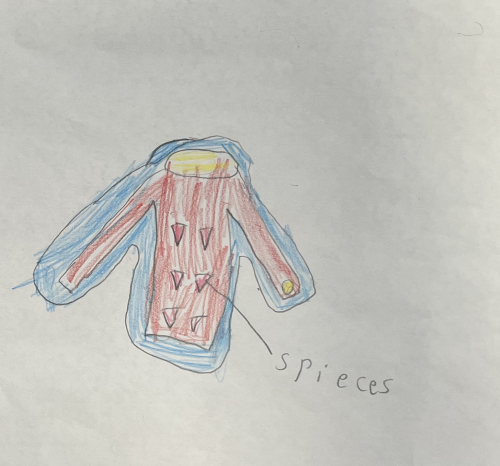
Lillie’s idea is a coat that puffs up like a pufferfish when you press a big yellow button. We’re working with Northumberland fashion and textile artist Meg Fletcher on the first designs, looking at how to get that big change in shape. Meg and I worked together on the light-up Technicolour Dreamcoat for Alnwick Playhouse, and it’s great to be making another coat together.
For the display, we’re looking at thin polyester fabric and small battery-powered fans. The fans would blow air into the coat to puff it up, then we could switch them off, let it deflate and do it all again.
If Lillie’s idea ever became a real product, one place to look for inspiration would be inflatable lifejackets. Some use a pull toggle to release gas from a small CO₂ cylinder into a folded pouch. The pouch opens up in seconds. A future coat could use a similar principle to push the fabric out quickly and give it that sudden pufferfish shape Lillie imagined.
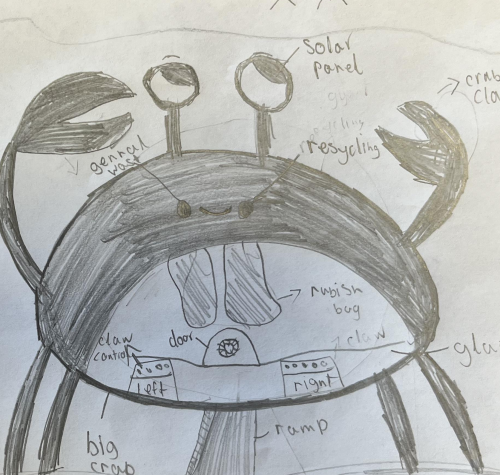
Isla’s come up with a giant robot crab that turns cleaning up the ocean into a game. Two players take a claw each and see who can scoop up the most rubbish. She even gave it solar panels for eyes!
We’re working with Molly again to turn Isla’s drawing into a model. She helped us with last year’s Little Inventors train projects and she’s always great to work with. It’s good to have her back as part of our extended team.
Molly’s plans show a bright orange, 3D-printed crab with moving claws and a little window where you can see the two control stations. We’re also looking at giving each claw its own button so two people can have a go at Isla’s game in a miniature underwater scene.
We've been working to help bring Dexter's 5G Power Paddle idea to life!
We had the opportunity to speak with Dexter about his invention and how he imagined it working, and we've since been exploring how to turn his idea into something physical.
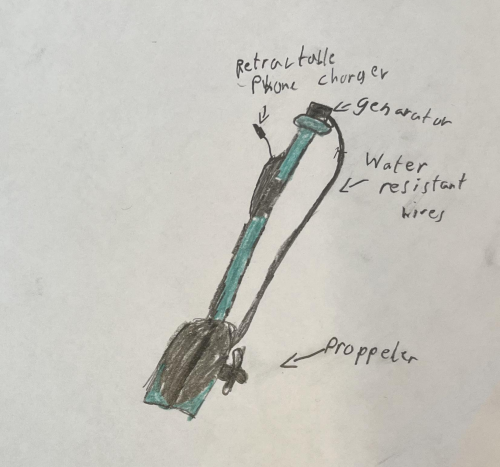
The concept is simple: could you use the movement of a paddle through water to generate electricity, storing that energy to charge a mobile phone later?
It's a great idea, though it comes with some interesting engineering challenges. Small generators aren't necessarily very efficient at low speeds, and a paddle only moves through the water for part of each stroke.
To put some numbers to it, if we could generate 5 watts continuously for four hours, we'd collect 20 watt-hours of energy—roughly what's stored in a typical smartphone battery. Achieving that from a paddle is another matter, particularly once we factor in energy losses!
What's particularly interesting is how technology keeps improving. As electric motors and generators become more efficient, especially at smaller sizes, we can recover useful energy from movements that previously produced too little electricity to bother collecting. Combine that with improvements in batteries and electronics, and ideas like Dexter's become increasingly practical. It's a great example of why an invention that might be difficult to achieve today could become much more viable in the future.
For this first stage, we're developing a small-scale display model to explore the concept and show how the different parts of Dexter's invention could work together.
We've started designing the paddle in SOLIDWORKS, with a small propeller integrated into the blade. The idea is that water passing through the paddle would turn the propeller, providing the movement needed to generate electricity. We're also exploring ways to make the model interactive and demonstrate how that energy could be collected and stored.
There's still plenty to work through, but that's all part of the fun of taking an invention from a drawing to a physical design.
We're looking forward to getting the parts made and seeing it come together!
Ideas brought to life
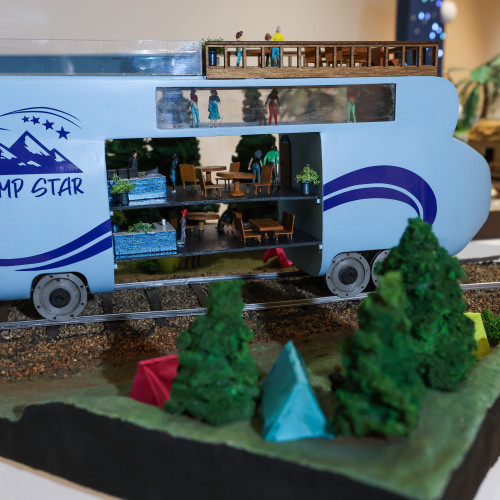
The Camp-Star
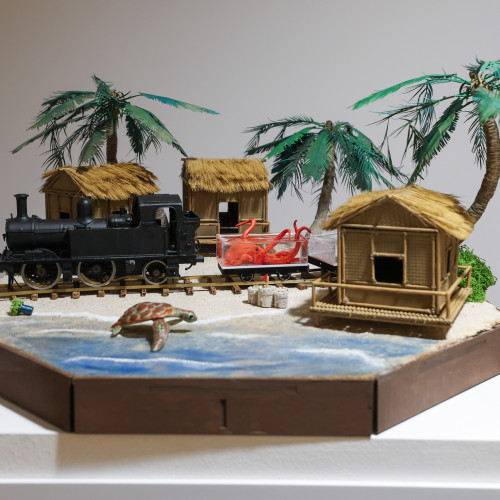
Aquarium Train
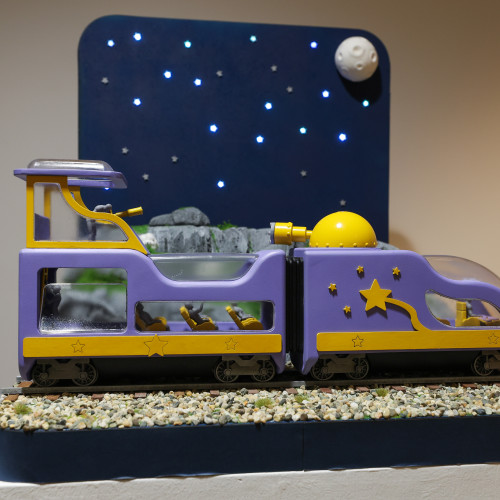
Star Gazer
Cinema on wheels
5G Power Paddle
Crabey 3000
Puffy coat